

Forecast: Gale Force Wind
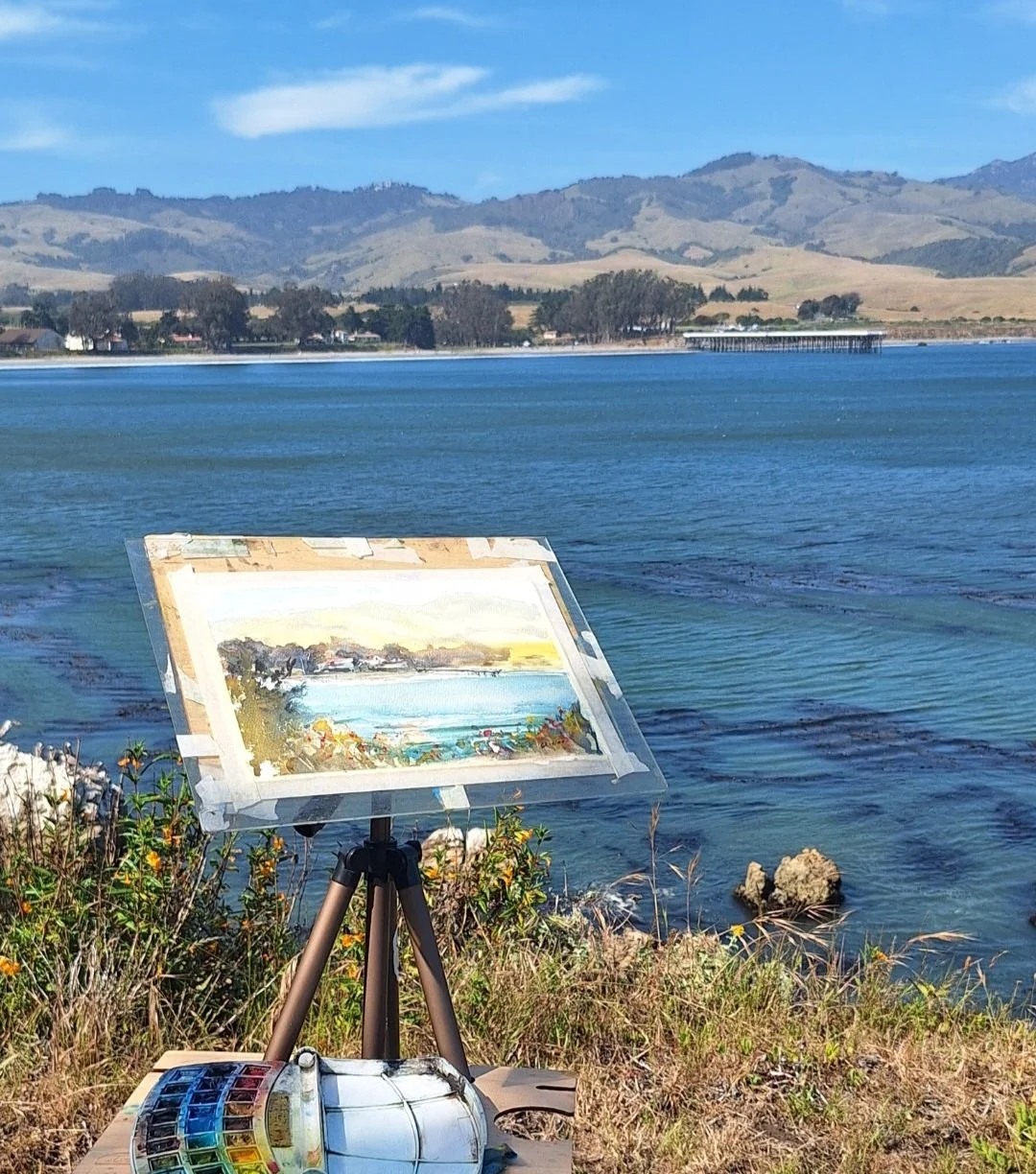
Potential lift off…
The forecast said gale force winds by noon, which in San Simeon translates to: don’t bother with a hat unless you’re ready to donate it to the Pacific.
Naturally, I packed my easel anyway.
Surfers and plein-air painters may share at least one similarity. We both look at weather alerts in much the same way. “Dangerous conditions” often sounds suspiciously like good waves, or good lighting in this case. So after a somewhat slow start, I loaded up the gear and hit off toward the bluffs above San Simeon.
At first, the coast was almost gentle. A pale marine layer hovered over the water like gauze. Elephant seals barked somewhere below the cliffs. Eucalyptus leaves clicked softly in the cool air. The ocean was all muted violets and cold steel blues — the kind of restrained palette that makes you mix color carefully instead of squeezing cadmium hues at every emotional inconvenience.
For twenty minutes, I believed I might actually get away with it.
Then the wind arrived.
Not gradually. Not politely.

Under seemingly constant pressure, San Simeon Eucalyptus.
One moment I was blocking in the horizon line; the next, a gust slammed into the easel hard enough to turn my canvas into a temporary sail. My plastic palette launched itself into the coastal scrub like a frightened seabird. The whole setup nearly catapulted toward the cliff edge with shocking confidence.
Painting outdoors is already an exercise in surrender. The light changes every few minutes. Shadows migrate. Clouds erase entire compositions. But wind adds a special layer of humility. Gale force wind doesn’t care about your composition. It doesn’t care about your carefully mixed greens or whether your paper is dry. It treats every object you own as airborne potential.
And yet, somehow, those are the days that stay with you. Because once the struggle stops being annoying, it becomes clarifying.
You stop obsessing over details because details are impossible. You paint faster. Bigger. Simpler. You begin chasing movement instead of accuracy. The cypress trees bend into calligraphic shapes. Waves flatten into broad strokes of multitudes of blue. The sky becomes less about clouds and more about momentum. The painting starts recording experience instead of scenery.
At several points, I used my own body as a windbreak while painting with one hand and holding the easel steady with the other. Any illusion of artistic elegance disappeared moments earlier. My jacket snapped in the wind like a sailcloth flag. Gust timed their approach with cunning. Random airborne debris embedded itself into wet paint.
And honestly? The painting got better.
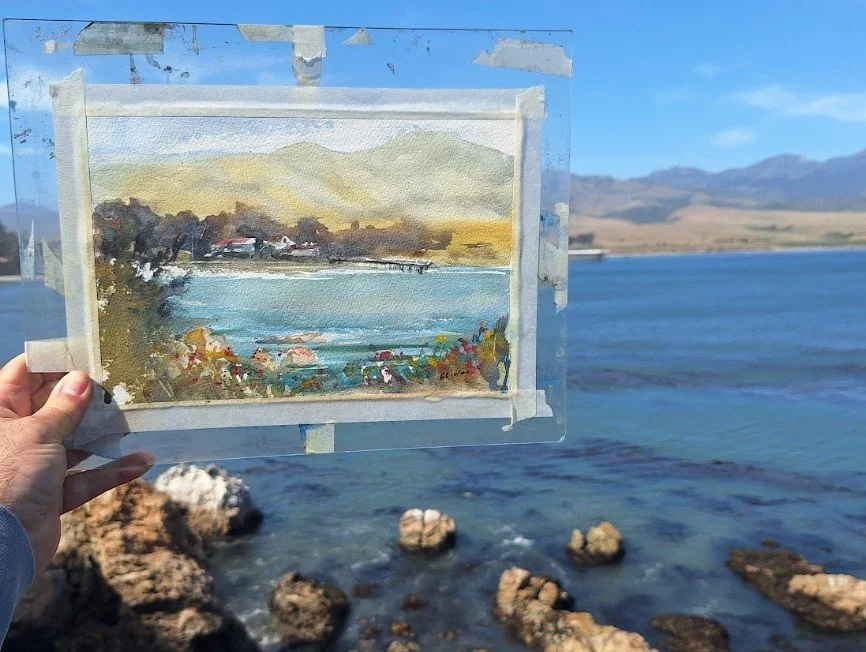
Calling it “done”.
There’s something about difficult weather that strips plein air painting down to instinct. You stop trying to control the landscape and start collaborating with it. San Simeon, especially, rewards that approach. This coastline isn’t delicate. It’s in control. Ancient. Windswept. The drama is built into the geology itself — fractured cliffs, restless water, trees permanently shaped by resistance.
A calm day can be beautiful there, yet a violent windy day feels truthful.
By mid-afternoon the gusts became ridiculous. The beachgoers were likely getting sandblasted. Whitecaps exploded offshore. Even the gulls looked inconvenienced. I took that as my cue to quit while I still possessed most of my equipment.
Back at the car, I looked at the painting expecting to hate it. But there it was: loose, imperfect, energetic — carrying far more of the afternoon than any carefully controlled studio piece could have managed. The brushwork leaned in the same direction as the trees. The horizon wasn’t perfectly straight. The colors were rougher than intended. But the wind had made its mark on the paper, and somehow that felt honest.
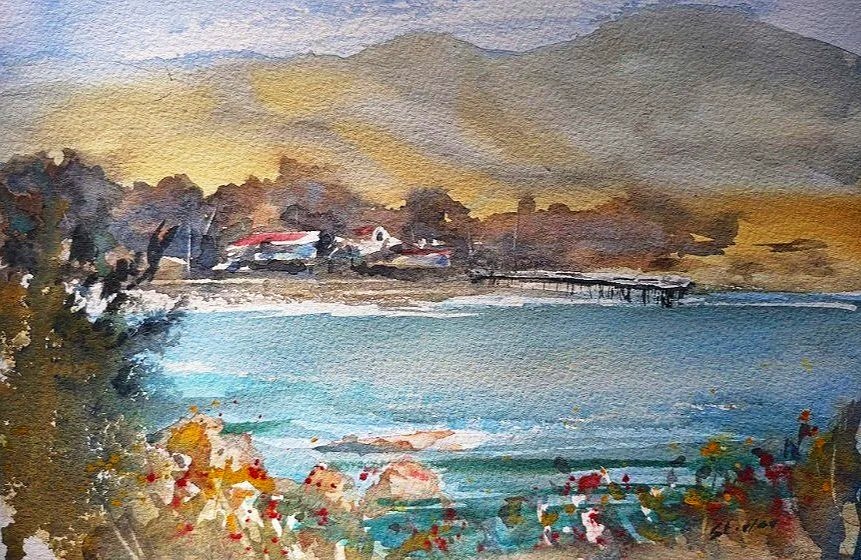
Final painting 7”x10”
Plein air painting often gets romanticized as peaceful and meditative — artists quietly painting lavender fields under perfect skies.
Sometimes it is.
Other times, it’s wrestling an easel beside a roaring ocean while trying not to lose your ultramarine to the Pacific. And strangely enough, those are the days that remind you why painting outdoors matters in the first place.
Not because it’s comfortable but because it’s alive.
